A one-page annual report template for clubs and booster clubs
The season ends, the banquet happens, and the club goes quiet. Then in August the sponsor letters go out again.
The hardware store that gave $500 last year never heard that its money helped buy two new goal sets. The principal doesn’t know how many kids got fee help. Families who worked the concession stand have no idea what their hours added up to.
Show people what their money did before you ask for more.
An annual report fixes that, and it doesn’t need to be a glossy booklet. For a volunteer club, one printed page is enough.
It should say what the club did, where the money went, and what comes next. Aim to send it within a month of the year’s end, and well before your next request for money.
Count things while they happen
The hard part of an annual report is finding the numbers in June. Did 221 kids play, or 312? Nobody remembers, and the registrar who knew has moved on.
So keep a running log from the first week. Each time something countable happens, one person adds a row: the date, the program, what was counted, the number, and where the number came from. A registration export, a sign-up sheet, and a receipt are all good sources.
Count each child once. A child who played fall and spring is one player and two registrations, so if you can’t tell them apart, say “registrations.”
Volunteer hours are easiest to capture when people sign in and out. VolunteerHub suggests capturing hours at check-in and check-out, and tagging them by program. A paper sign-in sheet at the concession stand works the same way.
The log also has a column for photos and stories, and a column for permission. If a parent sends a note about what fee help meant to their family, ask right away whether you can use it, and in what words.
Leave the family’s name out unless they ask to be named. Get a parent’s written okay before you use a child’s photo or name, and if the school is involved, check its photo policy too.
Download the numbers log as a spreadsheet. It has a year of example rows from a youth soccer club, plus blank rows for yours.
Fill the page in six blocks
Use the same six blocks each year, so readers learn where to look and next year’s officers know what to collect.
- Big numbers. Three or four counts from the log: players served, kids who got fee help, volunteer hours, equipment bought, or events held.
- Money in and money out. Copy these from the treasurer’s year-end report, and add a short list of what the money bought. If you waive fees for some families instead of paying them, say how many and how much. A waived fee never came in, so it isn’t money out either.
- Volunteer time. Hours, and what they’re worth.
- One story. A few sentences about one player, family, or classroom, used with permission.
- Thank-yous. Sponsors, the school, the parks department, and anyone who lent a field or a truck. Name sponsors only if they agreed to be named.
- Next year. One goal and one way to help, like “fee help for 50 players” and a link to give.
A good year-end report from the treasurer covers income and expenses by category, the surplus or deficit, and cash on hand. This booster club treasurer guide recommends presenting that report to the full membership at the annual meeting.
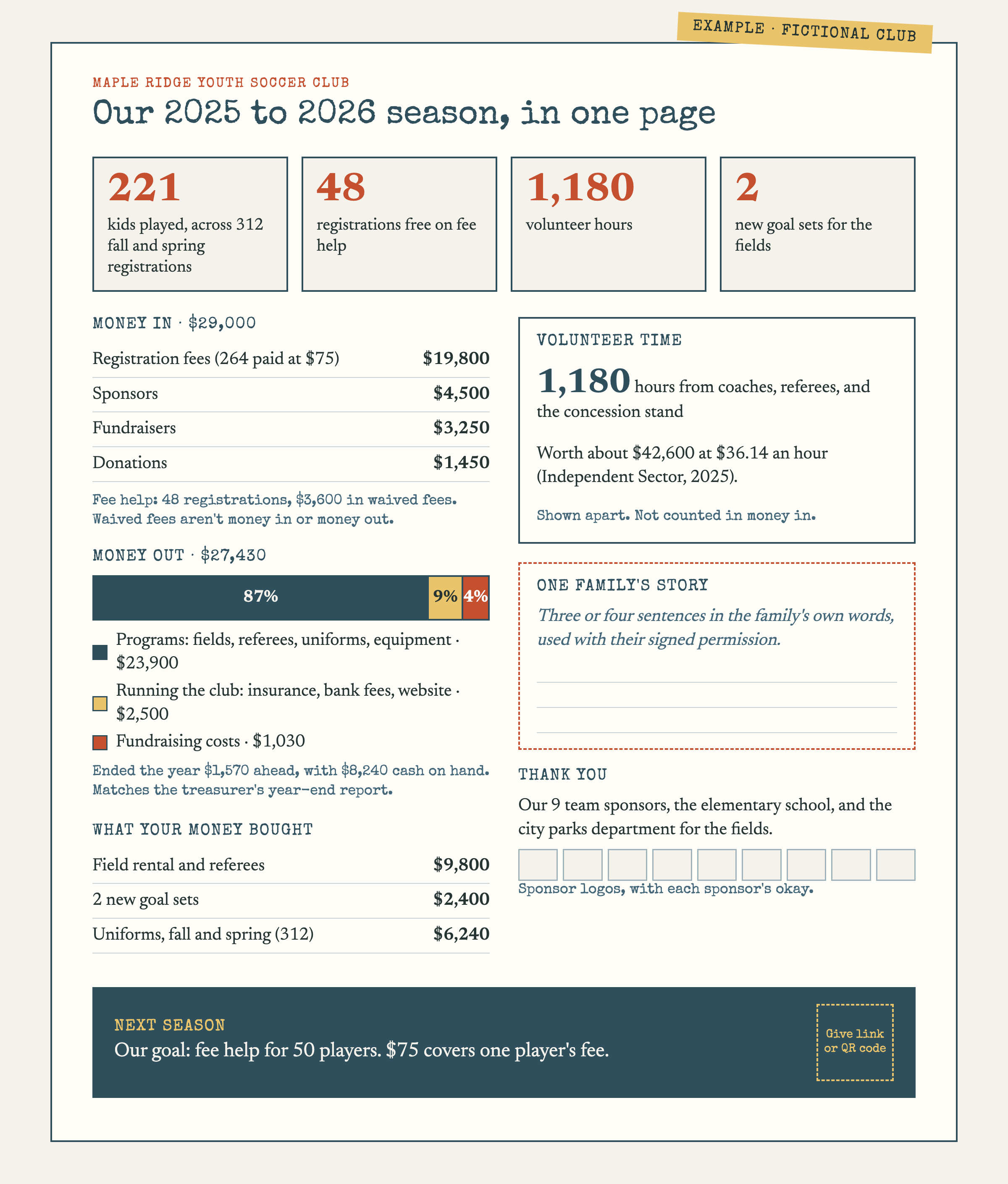
Print the annual report template to draft yours by hand. Page one has a box for each block. Page two has the checks to run and the list of who gets a copy.
To send it, type the six blocks, in the same order, into a one-page document in Google Docs or Word, and save or download it as a PDF. Put the big numbers in a four-column table and money in and out in two short tables. A neat handwritten page also works. Scan it with your phone and send that.
Sort spending the way the IRS does
For the money-out chart, use three buckets. These are the same columns the IRS uses on Form 990, Part IX, the statement of functional expenses (Form 990 instructions):
- Programs: what you exist to do. For a youth league, that’s fields, referees, uniforms, equipment, and any fee help you pay out.
- Running the club: insurance, bank fees, the website, and the post office box. The IRS calls this management and general.
- Fundraising costs: what you spent asking for money, like printing and postage for sponsor letters or ads for a donation drive.
If your club files Form 990 or 990-EZ, you have to make your returns available for public inspection and copying for three years after each one is due or filed (IRS public disclosure rules). Make sure the totals in your report match the return.
Many small clubs file neither. A club whose gross receipts are normally $50,000 or less can file the short Form 990-N e-Postcard, which has no money lines, so match the treasurer’s year-end report instead. If your club is covered by a state or national group exemption, the parent organization may file for you. Check with your treasurer or tax preparer if you’re not sure what you file.
This report is for your supporters. It doesn’t replace any annual report your state requires if your club is incorporated. Washington, for example, wants an annual report every year, and a late one can lead to administrative dissolution. Check your state’s rules.
Keep volunteer hours apart from the money
Volunteer time is worth stating in dollars. Independent Sector puts the national value of a volunteer hour at $36.14 for 2025, a preliminary figure released in April 2026. At that rate, the example club’s 1,180 hours come to about $42,600.
Show that figure on its own line, next to the hours, and don’t add it to money in. The Form 990 instructions say donated services, like volunteer time, don’t count as revenue or expenses on the return. On Form 990, a club can mention their value only in the program descriptions in Part III. Adding them to income in your report would make it disagree with your books.
Send it before you ask for anything
Send it to this list, then check each name off:
- Sponsors and donors, with a short personal note from the president.
- The principal, athletic director, or whoever you work with at the school.
- The city or county parks office, if you use its fields or rooms.
- The families on this year’s roster.
- Your board and committee chairs, so they can answer questions.
- Your website or social page, as a PDF anyone can open.
- Printed copies for the banquet table or the first meeting of the new year.
Send it as a PDF attached to a plain email, or as a link, with the three biggest numbers in the email itself. Here’s the example club’s email:
Subject: Our 2025 to 2026 season in one page
This year 221 kids played soccer with us. Fee help covered 48 registrations, and volunteers gave 1,180 hours.
The one-page report is attached, with where every dollar went. Thank you for being part of it.
(Your name), president, Maple Ridge Youth Soccer Club
The report doesn’t replace donation receipts. If your club is a 501©(3), a donor who wants to deduct a gift of $250 or more needs a written acknowledgment from you. Send those separately, as gifts come in.
The acknowledgment names the club. For a cash gift it gives the amount. For a donated item, like a raffle prize or a box of equipment, it describes the item without putting a dollar value on it. It also says whether the donor got anything in return, and if they did, it describes what they got and gives a good-faith estimate of its value (IRS written acknowledgment rules).
How you’ll know it worked
Check these targets when the next sponsor letters go out:
- The report went out within a month of the year’s end.
- Its money totals match the treasurer’s year-end report to the dollar.
- At least three sponsors or families replied to it.
- Most of last year’s sponsors renew, and fewer of them ask what the money was for.
- Filling in the page took one evening, because the log was already kept.
Further reading
- Value of volunteer time, Independent Sector
- Instructions for Form 990, Part IX: statement of functional expenses, IRS
- Form 990-N (e-Postcard) for small exempt organizations, IRS
- Public disclosure and availability of exempt organizations returns, IRS
- Booster club treasurer guide, HometownLift
From the sponsor
LongTable keeps your club’s roster, dues, events and RSVPs in one place, so you can spend your energy on the actual work.
See how LongTable works →