A one-page monthly treasurer's report template your board can follow
You’ve probably sat through both kinds of treasurer’s report. One is a stack of bank printouts that nobody reads. The other is a single line about how much is in checking. The board votes to buy new warm-up jackets, and two weeks later the uniform invoice arrives.
A bank balance on its own doesn’t tell the board enough. Some of that money is already owed to vendors. Some was given for a set purpose, like a scholarship. The number the board needs is what’s left after those, and a good report puts it on the page.
The fix is one page, in the same layout every month. The board learns where to look, the months line up side by side, and next year’s treasurer inherits a record they can follow.
What goes on the page, in this order
Start with a header: the club name, the exact dates covered, who prepared it, and the date it went out. Then fill in six sections.
- Cash summary. For each account, the beginning balance, money in, money out, and the ending balance. List every place the club holds money, including savings, a payment app balance, and the cash box. Each beginning balance must match last month’s ending balance. If it doesn’t, find out why before anything else. Most differences are a deposit recorded twice, two digits swapped, a bank fee, or a payment app transfer not yet recorded.
- Bank match. One line per bank account: the statement balance, minus checks that haven’t cleared, plus deposits that haven’t cleared, which should equal your records. Record any bank fee or interest on the statement in your books first. If there’s still a difference, find it before the report goes out. Note who did the match and who reviewed it.
- Budget vs. actual. Each budget line with its annual amount, this month, the year so far, and the percent used.
- Bills, promises, and money spoken for. Unpaid bills and reimbursements waiting to go out. Money promised to the club that hasn’t arrived yet. Donations given for a set purpose, and any reserve the board has voted to set aside.
- Free to spend. The total ending balance across all accounts, minus unpaid bills, minus money that’s spoken for.
- Decisions for the board. Anything that needs a vote, written as a motion.
National PTA’s guide to treasurer reporting asks for much the same thing: a report at each meeting, with a year-to-date comparison to the budget and the month’s bank reconciliation.
Print the one-page treasurer’s report. Page two shows it filled in for a made-up booster club.
Work out what’s free to spend
Here’s that example club at the end of September. It has $6,423.20 in checking. It owes $1,266.40 in bills, and $2,500 is spoken for. That leaves $2,656.80 free to spend. A $750 sponsorship promised for October goes on the report, but it doesn’t count until the check is deposited.
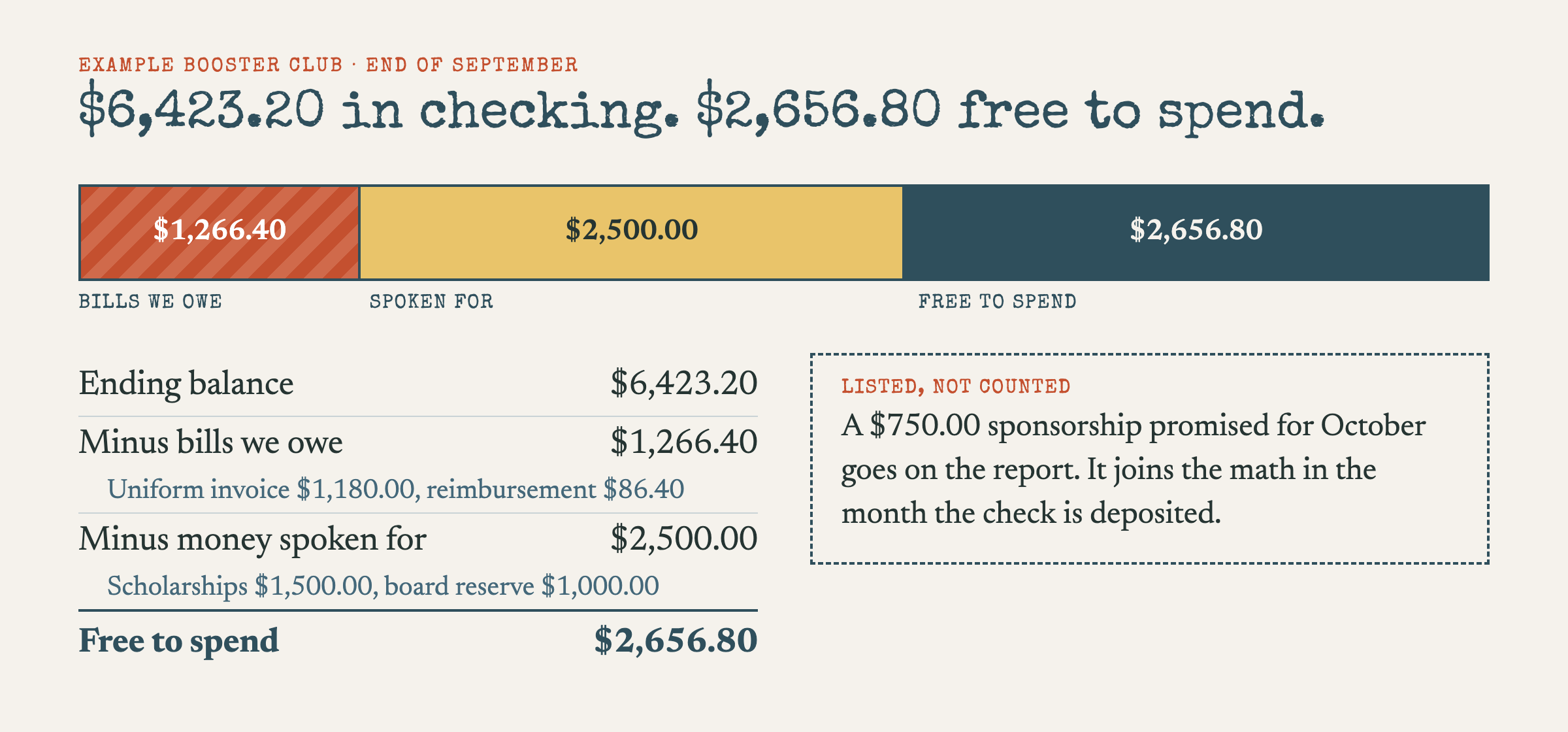
Free to spend is cash on hand today. It also has to carry the budget until the next deposits come in. Anything that isn’t in the budget, like those warm-up jackets, still needs a budget amendment approved the way your bylaws require.
Donations given for a purpose have to go to that purpose. New York’s attorney general lists honoring those restrictions among the controls a board should have in writing, in its internal controls guidance for nonprofit boards. Check your own state’s rules, usually through the attorney general’s charities office.
Compare each budget line to the calendar
The budget section is where a board catches trouble early. At the top, write how much of the year has gone by. Three months into a July to June year, that’s 25 percent.
Then flag lines that are running ahead. A workable rule is to flag any expense line 20 or more points ahead of the calendar, and any line that unpaid bills would push over budget. Each flag gets one sentence of explanation.
In the example, three expense lines are flagged. Insurance shows 97 percent used, but the yearly policy was paid in July. Spirit wear is at 50 percent because the club places one order a year, and sales cover it. Uniforms and equipment is at 81 percent, and the $1,180 invoice will put it $30 over. That line needs a budget amendment before the invoice is due on October 15.
The New York guidance recommends comparing actual income and spending to the budget “at least quarterly, preferably monthly,” with prompt explanations when they differ.
Download the budget vs. actual tracker. It has a column for each month of a July to June year, with the example club’s first three months filled in and blank rows for your own lines. Year to date, percent used, remaining, and the totals are formulas, so they update when you type in a month.
Record money in and money out separately, even for a fundraiser. If a cookie dough sale brings in $3,000 and the dough cost $1,900, record $3,000 in and $1,900 out. The IRS counts gross receipts, meaning everything received before costs, when it decides which annual return a group can file, including the short Form 990-N.
Send it two days before the meeting
Email it to the board at least two days before each meeting, so people read it at home and arrive with their questions ready. A monthly routine to try:
- Download the bank statement as soon as it’s ready.
- Match every deposit and payment to your records, and note anything that hasn’t cleared.
- Ask a board member who doesn’t sign checks to look over the statement and your match, and initial both.
- Update the budget tracker and write a one-line note for each flagged line.
- Fill in the one-page report and work out what’s free to spend.
- Email it with the statement attached, account number blacked out, two days before the meeting.
- Write any decision you need as a motion and send it to the president for the agenda of the meeting that votes on it.
The second reviewer matters. The same New York guidance says no one person should handle receiving, recording, and depositing money and also writing and signing checks.
Report what’s free to spend, and show how you got there.
How the board receives the report and handles budget changes
Keep the treasurer’s report off the consent agenda. BoardSource says financial statements shouldn’t go on one, so give the treasurer a few minutes of their own for questions.
Don’t ask the board to approve the monthly report unless your bylaws require it. The monthly report is received and filed. The formal sign-off comes later, when the year’s books are reviewed or audited. National PTA, for example, attaches the monthly report to the minutes, and its year-end report becomes official only after the audit. If your bylaws or your state or national organization say otherwise, follow them.
Flagged lines become motions. National PTA’s guide says budget changes must be presented as amendments to the budget. Bring each one as its own motion to whoever adopted the budget: the board, or the members if your bylaws or parent organization (state PTA, national office, league) say so. Washington State PTA, for one, tells its units that the budget can be amended by a members’ vote during the year. For the example club, the motion would be to move $100 from the coach gifts line to uniforms and equipment, so the invoice can be paid on time.
How you’ll know it worked
- The report goes out two days early every month, in the same layout.
- Every month’s beginning balance matches the month before.
- Nobody at the meeting asks how much money the club has.
- Flagged lines become budget amendments before the bill is due.
- A new treasurer can read last year’s twelve reports and understand the year.
Further reading
- Treasurer reporting in the local leader kit, National PTA
- Internal controls and financial accountability for not-for-profit boards, New York State Attorney General
- Consent agenda: what it is and how to use one, BoardSource
- Gross receipts defined, IRS
- Annual electronic filing requirement for small exempt organizations (Form 990-N), IRS
From the sponsor
LongTable keeps your club’s roster, dues, events and RSVPs in one place, so you can spend your energy on the actual work.
See how LongTable works →